
Europe rarely appears at the center of the global race for humanoid robots. Yet one company has been quietly building expertise in the field for more than two decades. Based in Barcelona, PAL Robotics is among the continent’s oldest humanoid robotics developers and continues to push new platforms for research and industry. But according to its CEO Francesco Ferro, Europe risks losing ground in a sector it helped pioneer, as Chinese and American competitors benefit from stronger industrial ecosystems, massive funding and faster execution.
Founded in 2004, PAL Robotics has built several generations of humanoid robots, from REEM-A to REEM-C and later TALOS, a research platform widely used in European laboratories. The company now employs teams in Barcelona, Toulouse and Italy, and serves clients across logistics, retail, healthcare and agriculture. At this year’s Mobile World Congress in Barcelona, the company unveiled its latest humanoid robot, Kangaroo, a system designed to integrate advanced perception and force control.
Despite this technological progress, Ferro warns that Europe’s position in robotics is becoming increasingly fragile. “We are losing know-how that we helped build,” he says, pointing to the growing gap between Europe and its global competitors.
A European robotics pioneer facing global competition
PAL Robotics has long been part of Europe’s robotics ecosystem. Over the past two decades, the company has developed humanoid platforms designed primarily for research and industrial experimentation.
Its best-known robot, TALOS, was introduced in 2017 and developed in collaboration with the LAAS-CNRS laboratory in Toulouse. The bipedal humanoid was designed as a research platform for dynamic locomotion and advanced manipulation. Equipped with torque-controlled joints and sophisticated sensors, TALOS allows researchers to study how robots can walk, balance and interact with complex environments.
TALOS quickly became a reference platform for European robotics labs and research projects. One of the early industrial partners exploring humanoid robots with PAL Robotics was Airbus, which tested the use of bipedal robots for factory operations.
The company’s newest humanoid, Kangaroo, builds on this technological lineage. The robot integrates advanced perception systems and torque control embedded in its joints, allowing it to interact safely with its surroundings.
For Ferro, the technology reflects years of accumulated research. Kangaroo, he explains, represents “the state of the art in robotics in terms of sensors and perception,” enabling more precise and dynamic interactions with the environment.
Yet technological progress alone may not be enough to secure Europe’s place in the global race. Ferro believes the continent is struggling to keep pace with faster-moving competitors.
“In Europe, on the bureaucratic side, we have not yet found the right rhythm to move forward,” he says. “Meanwhile we are competing on a global stage.”
Chinese robotics companies such as Unitree and AgiBot benefit from significant state support and large-scale manufacturing capabilities. In the United States, robotics startups can rely on venture capital and partnerships with major industrial companies eager to deploy automation technologies.
Europe, Ferro argues, lacks both the scale of funding and the industrial momentum seen elsewhere. “Sometimes, instead of feeling supported, we feel more constrained,” he says.
A diversified robotics portfolio beyond humanoids
Although humanoid robots attract the most attention, PAL Robotics’ business extends far beyond bipedal machines.
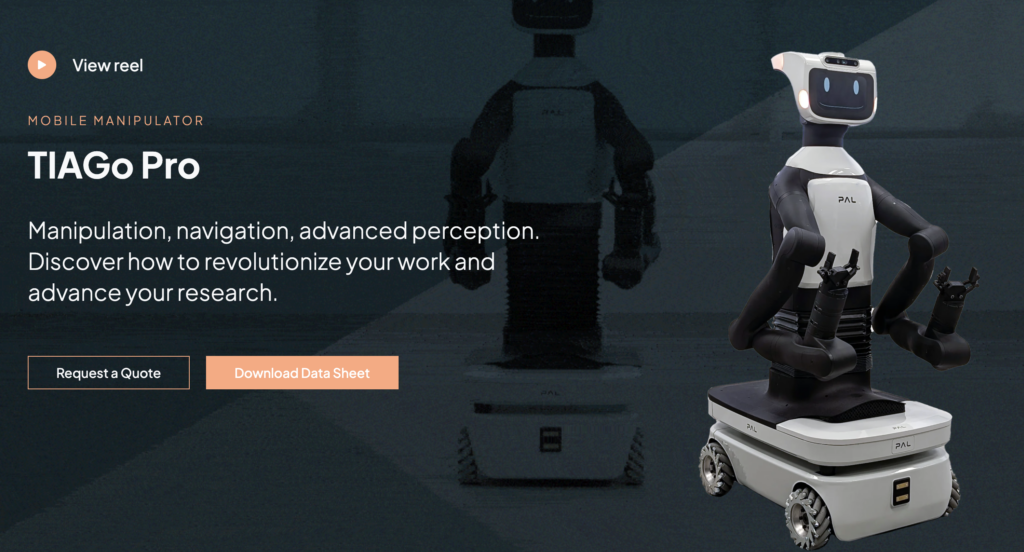
One major activity focuses on mobile manipulation robots, particularly the TIAGo Pro platform. These robots combine mobile bases with robotic arms capable of performing pick-and-place operations, moving objects and collaborating with other automated systems in logistics or manufacturing environments.
Another business unit focuses on intralogistics and retail automation. The company’s StockBot robots are designed to perform autonomous inventory checks inside retail stores. Equipped with sensors and computer vision systems, the robots can scan shelves and detect stock levels.
PAL Robotics has deployed these systems with retailers such as Decathlon. According to the company, its robots now operate in around fifteen countries and perform daily inventory tasks in stores across roughly forty markets.
The company is also expanding into new sectors. Healthcare is one promising area, particularly in hospitals and elderly care facilities where staff shortages are becoming a growing concern. PAL Robotics is currently involved in several pilot projects exploring how robots could assist caregivers and patients.
Agriculture represents another strategic market. In European research projects, the company is developing robotic solutions capable of operating in vineyards to help with tasks such as grape harvesting or pruning.
“The agriculture sector is strategic,” Ferro says. “Labor is becoming scarce, while food production remains a fundamental and long-term need.”
The industrial and economic challenges of robotics in Europe
Despite growing demand for automation, building robots in Europe remains difficult.
The cost of advanced robots has dropped significantly over the past decade. According to Ferro, machines that once cost up to €900,000 can now be built for around €200,000. Yet European manufacturers still struggle to compete with Asian companies on price.
Part of the problem lies in supply chains. While PAL Robotics tries to source motors, gearboxes and electronics from European suppliers, many critical components, such as certain batteries or electronic parts, are only available from Asian manufacturers.
The Covid-19 pandemic highlighted these vulnerabilities. Component shortages disrupted production and underscored the importance of maintaining local manufacturing capabilities for strategic technologies.
Beyond hardware challenges, robotics development also requires complex integration work across mechanical engineering, electronics, control systems and software. Ensuring reliability remains one of the biggest hurdles: in many industrial sectors, robots must approach near-perfect uptime to be economically viable.
For Ferro, the long-term rationale behind humanoid robots remains clear. Factories, warehouses and infrastructure were designed for humans, not machines.
“It’s very simple,” he says. “All existing factories were designed for people. Humanoid robots can integrate into those environments.”
But whether Europe will remain a major player in that future remains uncertain. Without stronger industrial support and faster execution, Ferro fears the continent could gradually fall behind in one of the defining technologies of the coming decades.