Long considered artifacts of the future on the same level as flying cars, humanoid robots are finally preparing to enter everyday life. All signs point to 2026 as the year the market for humanoid robots truly accelerates, with major announcements and early industrial deployments around the world.
In just a few days, Honor is expected to unveil its first humanoid service robot at the Mobile World Congress in Barcelona. Meanwhile, Tesla is preparing large-scale production of its Optimus robot, targeting global commercialization as early as 2027, although no official release date has been confirmed. Elon Musk has previously suggested a long-term price objective between $20,000 and $30,000 once production scales.
Some analysts describe this moment as the beginning of a new industrial revolution, comparable to the rise of personal computers, smartphones and artificial intelligence. Research firm IDTechEX estimates that the humanoid robot market could reach $30 billion by 2036, driven by rapid advances in AI, hardware miniaturization and manufacturing scale.
We present here the five humanoid robots most likely to shape the coming months and years.
Tesla Optimus
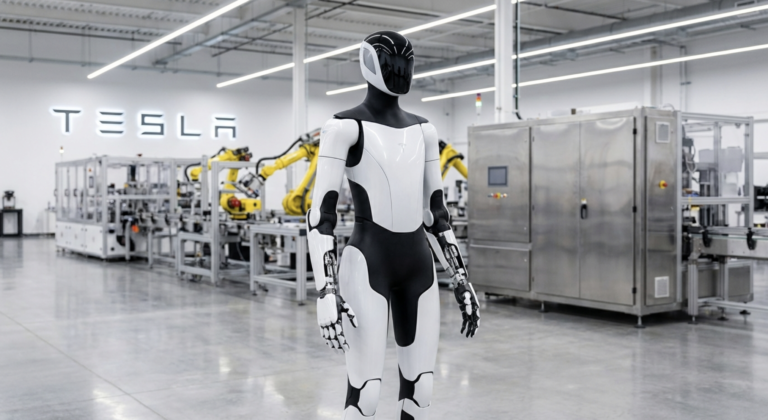
After electric vehicles, Tesla is betting on humanoid robots. The company led by Elon Musk is preparing to industrialize its humanoid robot Optimus, with commercial sales expected to begin as early as 2027, though no official preorder process has been opened yet.
Tesla Optimus is currently in its second generation, with a third version anticipated in the coming months. The robot stands approximately 1.73 meters tall and weighs around 57 kilograms. Designed with human-like proportions, it is intended to operate in environments built for people — climbing stairs, carrying objects and navigating industrial facilities without structural modifications.
The robot is powered by a 2.3 kWh battery, described as sufficient for “a light workday.” Tesla designs its own actuators, electronics and AI systems in-house, allowing it to pursue economies of scale similar to those achieved in its automotive business. Optimus relies primarily on camera-based vision, using AI systems derived from Tesla’s Full Self-Driving neural network architecture to perceive and interact with its environment.
Tesla has indicated that Optimus will eventually follow a hybrid model: hardware sales combined with optional software subscriptions for advanced capabilities and updates. While no official price has been announced, Tesla’s long-term target remains between $20,000 and $30,000.
Unitree G1
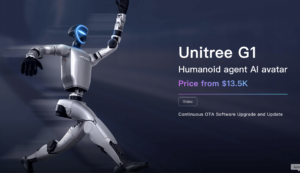
Considered one of the main competitors to Tesla’s Optimus, the Unitree G1 recently gained global visibility. A viral video showed a troupe of Unitree G1 humanoid robots performing a synchronized dance during China’s Spring Festival Gala, as the country welcomed the Year of the Horse in front of hundreds of millions of viewers.
First unveiled in 2024, the G1 — the smaller sibling of Unitree’s H1 — has undergone significant upgrades since its initial presentation. It was designed with the ambition of becoming the first truly mass-market humanoid robot, and it appears well positioned to pursue that goal.
The G1 is already available for purchase at $13,500, a relatively accessible price point for a humanoid robot, comparable to that of a compact car.
To reach this price level, Unitree made strategic design trade-offs, notably by reducing the robot’s size. The G1 stands just 1.27 meters tall and weighs approximately 35 kilograms. With proportions closer to those of a child, as seen in demonstration videos from China where it performs kung fu movements alongside young students, the smaller form factor also contributes to improved stability and lower energy consumption.
In terms of dexterity, the G1 features an extra-large joint movement range and between 23 and 43 joint motors depending on configuration. Its control system is driven by imitation learning and reinforcement learning techniques. The robot is equipped with force-control dexterous hands capable of precise object manipulation. By combining force-position hybrid control, it can perform delicate operations with a level of sensitivity and reliability designed to approximate human hand movements.
The robot integrates a removable battery housed in the torso, with an announced operating time of approximately two hours, depending on usage.
For perception and navigation, the G1 includes RGB cameras, optional depth sensors depending on the version, and integrated microphones. It is compatible with external AI models, allowing developers to customize and extend its capabilities.
While conceived in part to test the consumer market, the G1 is also likely to attract universities, AI research labs and startups. Its relatively affordable pricing and modular architecture make it a potential development platform for building new applications, experimenting with embodied AI systems, and accelerating research in humanoid robotics.
Figure 03

The humanoid robot Figure 03, developed by the startup Figure AI, is presented as a general-purpose robot designed for domestic tasks. According to the company, it can fold laundry, load dishwashers, organize household items and water plants.
Figure AI plans to scale production through the construction of a manufacturing facility called BotQ, designed to eventually produce up to 12,000 units per year. However, while manufacturing ambitions are clear, large-scale deployment will depend on technical validation and sustained real-world performance.
Figure 03 stands approximately 1.73 meters tall and weighs around 61 kilograms. It can carry loads of up to 20 kilograms and has a stated battery life of roughly five hours, depending on usage conditions.
The robot is powered by Helix, Figure’s proprietary AI system. Helix is described as a generalist Vision-Language-Action model that integrates perception, language understanding and motor control into a unified neural architecture. It allows continuous upper-body control, manipulation of unfamiliar objects based on natural language instructions and coordination between multiple robots. The system runs on embedded, low-power GPUs inside the robot itself.
No official release date has been announced, and the level of full autonomy in unstructured home environments remains to be independently validated.
Agility Robotics Digit
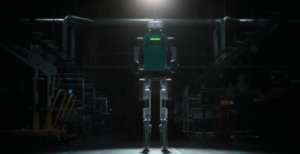
Developed by Agility Robotics, the humanoid robot Digit is emerging as one of the first humanoids moving from pilot programs to real commercial deployment. Designed specifically for logistics and manufacturing environments, Digit is built to operate directly on facility floors without requiring costly infrastructure changes.
Standing approximately 1.75 meters tall and weighing around 65 kilograms, Digit is capable of handling repetitive material-handling tasks such as transporting bins and supporting supply chain workflows. Unlike humanoids marketed primarily for domestic use, Digit focuses on industrial return on investment. Agility pairs the robot with Agility Arc, a cloud automation platform used to deploy, monitor and manage fleets of Digits at scale, signaling a shift toward integrated hardware-plus-software automation.
In February 2026, Agility Robotics announced a commercial Robots-as-a-Service (RaaS) agreement with Toyota Motor Manufacturing Canada following a successful pilot deployment. Under the agreement, Toyota plans to deploy Digit in its production facilities to assist with manufacturing, supply chain and logistics operations.
The companies indicated that the robots will initially support employees in repetitive and physically demanding tasks, with the longer-term objective of improving safety and operational efficiency. Toyota joins other major corporations — including Amazon, GXO and Schaeffler — that have tested or deployed Digit in industrial settings.
Rather than positioning Digit as a consumer product, Agility is advancing a human-centric automation model aimed at augmenting the workforce amid global labor shortages. While pricing is not publicly disclosed, deployments are structured through service agreements rather than direct retail sales. If scaled successfully, Digit could become one of the first humanoid robots to demonstrate sustained economic viability in real production environments.
AgiBot A2 Ultra
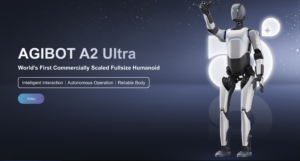
China’s humanoid robotics race is not limited to Unitree. The A2 Ultra, developed by AgiBot (Shanghai Zhiyuan Robotics), represents a different strategic approach: prioritizing public-facing service deployment and endurance performance over immediate industrial heavy lifting.
Standing approximately 1.69 meters tall and weighing around 69 kilograms, the AgiBot A2 Ultra features roughly 40 degrees of freedom, enabling fluid upper-body gestures and stable bipedal locomotion. The robot is designed for reception, guidance and interactive tasks in controlled indoor environments such as exhibitions, retail spaces and transport hubs. Its onboard AI compute — reported in the hundreds of TOPS range — supports speech interaction, navigation and real-time perception.
One of the most notable demonstrations associated with the A2 series was a long-distance autonomous walking test covering more than 100 kilometers over several days, highlighting durability and balance rather than manipulation strength. Battery life is typically cited at around two to three hours per charge, with swappable battery options to reduce downtime.
Unlike platforms explicitly targeting factories or households, the A2 Ultra appears positioned as a bridge between showcase robotics and scalable service automation.