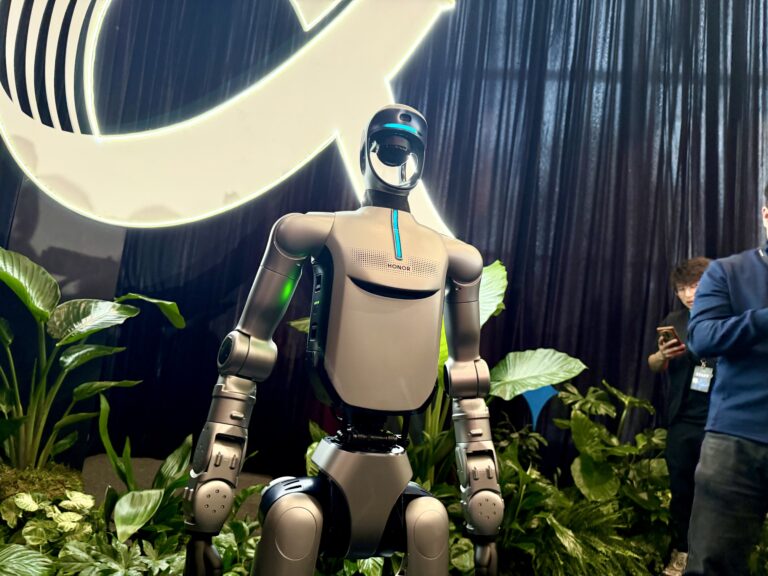
A humanoid robot opened this year’s Mobile World Congress with a carefully choreographed performance, signaling a subtle but meaningful evolution for a trade show historically centered on smartphones and telecom infrastructure.
Presented by Chinese technology group Honor, the machine was more than a spectacle: it was positioned as a physical embodiment of the company’s artificial intelligence ambitions. While many expected incremental upgrades or a new handset category, few anticipated a full-scale humanoid stepping into the spotlight.
A robot as a statement of intent
In the days leading up to its keynote, Honor teased an announcement that would go beyond a conventional smartphone launch. Speculation ranged from AI-powered services to a radically redesigned device. Instead, the company revealed both a new “Robot Phone” and a humanoid robot designed to illustrate its broader technological direction.
The humanoid robot has just walked onto the stage at #MWC26 — delivering an impressive choreographed performance.
Now, the CEO presents the vision behind the project.
Honor moves from AI ecosystem talk to embodied robotics. #AI #robotics pic.twitter.com/PqbedmFcDb
— Mattis Meichler (@mattis_urs) March 1, 2026
The smartphone itself features advanced on-device AI and a motorized rear camera module capable of automatically adjusting angles and tracking subjects in real time. By combining sensors, small motors and artificial intelligence, the device introduces a degree of physical movement rarely seen in handsets. The humanoid robot, unveiled moments later, appeared as an amplified version of the same philosophy: AI that does not merely compute, but acts.
Standing upright and roughly human-sized, the robot joined professional dancers in a short routine before attempting a moonwalk, drawing audible reactions from the audience. Honor’s CEO then engaged the machine in a brief exchange, showcasing its ability to respond to voice commands. The demonstration concluded with a backflip — a carefully timed finale that reinforced the event’s theatrical dimension.
Between prototype and strategy
Despite the spectacle, many questions remain unanswered. Honor has not disclosed detailed technical specifications, nor has it outlined a clear roadmap toward commercialization. Observers are left to determine whether the humanoid is primarily a research platform, a branding exercise, or the first sign of diversification beyond the company’s core portfolio of smartphones, tablets and laptops.
Hands-on demonstrations after the keynote offered a closer look. The robot responded to basic commands and executed programmed sequences with relative precision. Yet its movements, though technically impressive, lacked full fluidity. Company staff remained nearby during interactions, suggesting that the system’s autonomy is still limited. For now, it appears better suited to controlled environments than to independent operation in public spaces.
Even so, the broader significance extends beyond Honor alone. This year’s MWC features a noticeable uptick in robotics exhibitors (AgiBot, MagicLab), highlighting the growing convergence between artificial intelligence software and embodied machines. What was once confined to research labs is increasingly making its way onto commercial stages.
Honor’s showcase aligns with the industry’s push toward so-called “embodied AI” — systems capable of perceiving, moving and interacting in the physical world. By pairing a motorized smartphone with a humanoid robot, the company underscored its belief that the future of AI will not be limited to digital assistants on screens.