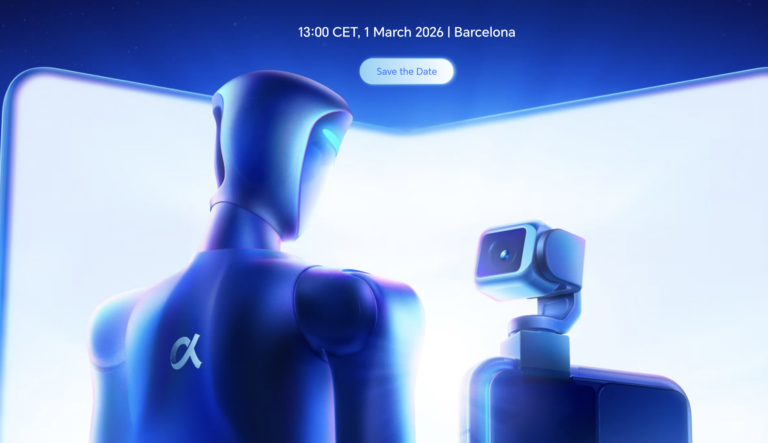
The humanoid robot revolution is entering a new phase — and it is no longer confined to automakers and specialized robotics startups. Chinese smartphone manufacturer Honor will present its first humanoid robot this Sunday at Mobile World Congress (MWC) in Barcelona.
The announcement reflects a broader shift in the technology industry. Embodied artificial intelligence is increasingly viewed as the next hardware frontier, extending beyond screens and voice assistants into physical machines capable of moving, manipulating objects and interacting in the real world. At the same time, the competitive landscape is tightening, with American and Chinese firms racing to dominate what could become a multi-billion-dollar global market.
Here is what we know — and how this fits into the wider industrial and geopolitical contest.
A humanoid robot linked to Honor’s AI-powered “robot phone”
So far, Honor has released only limited technical details. A teaser video shows a sleek black humanoid robot with glowing blue eyes, but the company has not disclosed specifications such as height, weight, degrees of freedom, payload capacity, battery life or the precise AI architecture powering the system.
Only 2 days left until the future unfolds! ✨
We can't wait to show you exactly how Robot Phone perfectly merges two ideas.
What are you most excited to see from HONOR? Let us know! pic.twitter.com/opLrsErGDT— HONOR (@Honorglobal) February 27, 2026
According to a Bloomberg report, the robot may focus on consumer-oriented applications rather than on industrial automation or heavy domestic labour. Shopping assistance has been cited as a potential use case, suggesting retail interaction or personal AI support rather than factory-floor deployment.
The humanoid will be showcased alongside Honor’s so-called “robot phone,” first introduced at CES earlier this year. The teaser footage implies close integration between the two devices, with the robot shown approaching the smartphone as if preparing to interact with it.
Honor describes the concept in deliberately evocative language, referring to a device with “the super brain of AI” and “the super mobility of a robot” that can transform into a personal camera. The phone itself features a small robotic arm equipped with a camera module, functioning as an integrated stabilization system comparable to products from DJI, which are widely used by content creators.
No pricing, production schedule or commercialization roadmap has been confirmed for the humanoid robot. At this stage, it could represent either a near-term consumer product or a strategic demonstration designed to signal Honor’s long-term AI ambitions.
After Tesla Optimus: Unitree, Hyundai and Figure accelerate the global battle
Honor’s entry comes as competition in humanoid robotics intensifies. Tesla helped bring mainstream attention to the sector with its humanoid robot, Optimus. Although CEO Elon Musk has outlined ambitious scaling goals, large-scale production remains in early phases, with initial units expected to be deployed internally before broader commercialization.
In China, Unitree has introduced the G1 humanoid robot, positioning it as a more affordable platform that leverages China’s dense manufacturing ecosystem. By controlling key components and focusing on cost efficiency, Unitree is attempting to make humanoid hardware economically viable at scale.
In the United States, Figure AI is developing its next-generation humanoid, often referred to as Figure 03. The company is targeting logistics and industrial environments first, betting that enterprise adoption will provide clearer return-on-investment metrics before expanding toward consumer applications.
Meanwhile, Hyundai, through its robotics activities, continues to advance mobility and manipulation technologies, reflecting the automotive sector’s growing interest in humanoid platforms as extensions of manufacturing automation.
Beyond product announcements, a broader US–China strategic rivalry is emerging. The United States maintains leadership in advanced AI models, semiconductor design and venture capital funding. China, however, benefits from large-scale manufacturing capacity, supply chain integration and state-backed industrial policy. Research firm IDTechEx estimates that the humanoid robot market could reach $30 billion by 2036, but ultimate dominance will likely depend on cost reductions, AI performance, chip access and regulatory environments.
Honor’s unveiling at MWC illustrates how quickly humanoid robotics is expanding beyond niche engineering circles into mainstream consumer technology strategy. The core question is no longer whether humanoid robots will reach the market. It is which ecosystem — American or Chinese — will succeed in industrializing them at scale first.