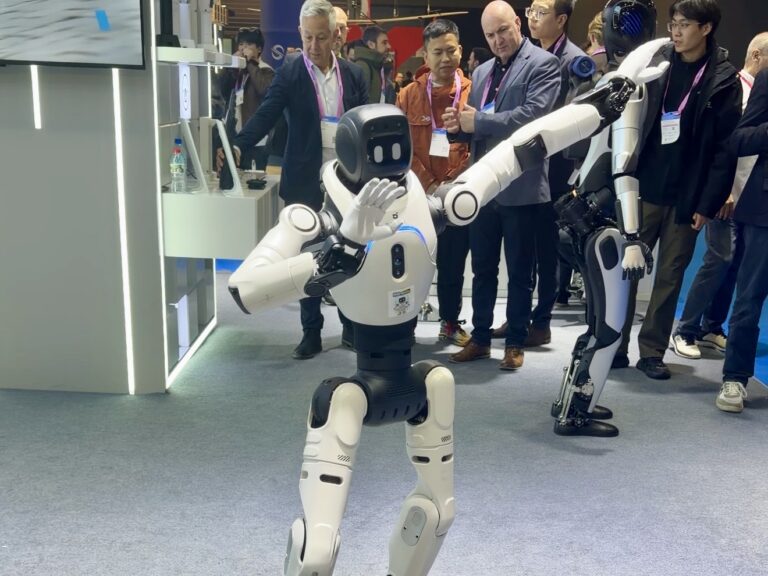
The humanoid robot race is shifting from prototype demonstrations to early industrial scaling. Chinese start-up AgiBot claims it produced more than 5,000 robots in 2025, roughly 40% of global output in a market estimated at around 13,000 units last year. Now, the company is targeting Europe as its next growth frontier.
At the Mobile World Congress, William Shi, President of AgiBot Europe and former head of Huawei France, laid out a strategy centered on ecosystem building, localization and partnerships. His thesis: humanoid robots are structurally suited to human environments — but scaling them remains a data and production challenge.
Scaling Production in a Nascent Global Market
Founded in 2023, AgiBot has structured its offering around three product lines. Lumi (X2 series), a 35-kilogram humanoid robot designed for entertainment and events; A2, a full-size humanoid built for public interaction in retail or transport hubs; and G2, an industrial-oriented platform currently performing simple tasks in factories. All three are already sold in China and technically ready for European export.
Based on internal estimates and industry reports, Shi says global humanoid production reached about 13,000 units last year. “In 2025, our production exceeded 5,000 units, representing about 40% of the global market.” He adds: “We are therefore ranked number one worldwide in terms of volume — although that does not mean much at this stage.”
Day 1 at MWC 2026!
AGIBOT robots are stealing the show with cool moves. Intelligence has rhythm. From Barcelona, sharing the next-gen robot with the world.
Visit us at MWC 2026!
📍 Hall 6, Booth 6A50 – Our main showcase for full-stack robotics and data-driven localization… pic.twitter.com/7oDAyKGWHO— AGIBOT (@AGIBOTofficial) March 2, 2026
The nuance is important. Tens of thousands of units remain marginal compared to automotive or even industrial robotics volumes. “Today, 10,000 or 20,000 units is still very small. The most important thing is to build the right ecosystems and work together.” Shi compares the sector to the early automotive industry: specialization across motors, design, software and manufacturing will likely define the next phase.
Competition is intense on both sides of the Pacific. In the United States, Tesla, Figure AI and Agility Robotics are pushing industrial automation. In China, players such as Unitree Robotics and Fourier Intelligence are expanding aggressively.Yet Shi argues that all actors face the same structural bottlenecks: scaling hardware production and collecting sufficient embodied AI data. “For this new generation of robots, we need enormous volumes of data. We still do not have enough data to rapidly evolve AI systems.” Unlike large language models trained on web-scale text, humanoid systems must learn from physical interaction — manipulation, balance, tool use — which is slower and costlier to capture.
Price remains another constraint. “Today, prices are still high. A robot costs almost as much as a car.” AgiBot’s entry models start around $20,000. However, Shi expects costs to decline as automation and competition intensify. “With competition, prices fall and technology advances faster.” The company is also developing an 80-centimeter consumer-oriented robot aimed at improving affordability.
Europe as a Strategic Ecosystem Play
For AgiBot, Europe is not simply an export market — it is a strategic terrain. “The European market is strategic for us. It is still at an early stage in humanoid robotics and does not yet have dominant players.” In other words, the competitive landscape remains open.
Shi’s approach is partnership-driven. “A robot cannot exist alone. You can compare it to a chatbot — but with a physical body.” The platform combines robotics hardware, AI models and cloud-based processing. Localization is therefore essential. While AgiBot’s systems operate in Chinese and English, expanding to French, German or Spanish requires local language model integration and compliance with European data infrastructures.
To that end, AgiBot collaborates with global cloud providers active in Europe, including Alibaba Cloud, Amazon Web Services and Microsoft. These partnerships allow robots deployed in Europe to access local data environments and language capabilities. “For French, German, Spanish or Italian, we must work with local partners.”
Beyond language, sector adaptation is critical. Industrial and service use cases differ significantly across European markets. “If robots are to work across different industries, we must understand the specific needs of each sector.” That is partly why the company showcased its technology at MWC: to meet integrators, AI specialists and industry players.
Underlying this expansion strategy is a clear technological conviction. “When a robot looks like a human, it can use tools designed for humans.” Stairs, pens, scissors, retail counters — most physical infrastructures are optimized for human morphology. “In short, a humanoid robot can adapt more easily to the human world.” At the same time, AgiBot pragmatically adapts its designs: its industrial model does not use legs, prioritizing stability over anthropomorphic fidelity.
Looking ahead, Shi projects rapid progress. “At this time last year, our robots could only walk. Today, they dance and perform complex movements.” Within three to five years, he believes households may begin to see tangible value in such systems.