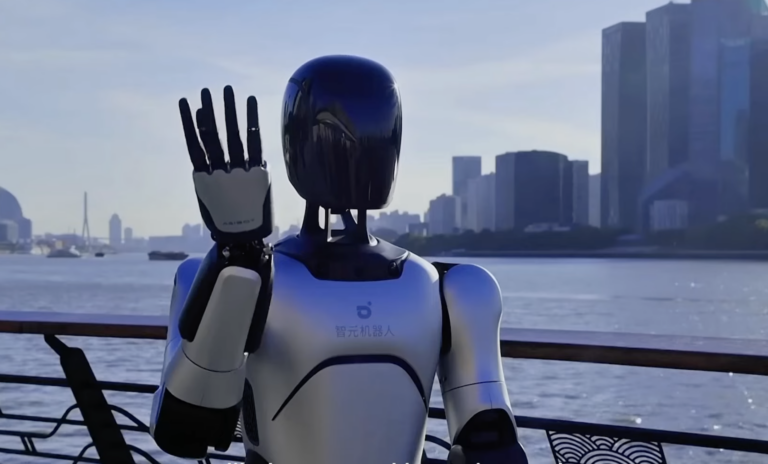
In the race for global leadership in humanoid robotics, AgiBot is emerging as one of the most serious contenders. The company says it generated $142 million in revenue in 2025 and sold nearly 5,000 robots — even as the global humanoid robot market remains in its infancy, estimated at around $500 million this year.
If those figures hold, AgiBot alone would account for more than a quarter of the global market, making it the world’s number one player in a sector that is still in the early stages of industrialization.
A sign of its growing prominence: the Chinese manufacturer — known domestically as Zhiyuan Robotics — is one of the few humanoid robotics companies present at the Mobile World Congress in Barcelona, taking place from Monday to Wednesday. The event serves as a strategic platform to showcase its international ambitions.
The G2: AgiBot’s Commercial Flagship
Founded in 2023, AgiBot set out to build versatile humanoid robots at relatively accessible price points. Its immediate focus has been industrial deployment at scale. Logistics, factories and warehouses represent the company’s primary target markets.
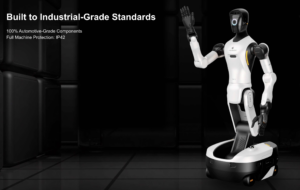
At the center of this strategy stands the G2, AgiBot’s commercial flagship. Launched in October and recently updated, the G2 is designed specifically for industrial environments — assembly lines, material handling and structured factory settings. It is the model most closely associated with the company’s reported revenue growth and large-scale deployments.
During its October 2025 launch event, four live demonstrations highlighted real-world use cases. In automotive parts manufacturing, the G2 worked alongside human operators on seatbelt lock cylinder assembly and material handling. For precision tasks, its force-controlled arms and learning algorithms enabled it to master RAM insertion in under an hour of training.
“We envision the G2 relieving humans from repetitive, labor-intensive and safety-risk-prone tasks, enabling people to focus on more creative work,” said Yao Maoqing, Partner at AgiBot and President of the Embodied Business Unit.
The A2 and the Broader Humanoid Vision
While the G2 drives industrial revenue, the A-Series — and particularly the A2 — reflects AgiBot’s broader ambition of building general-purpose humanoid systems.
Since launching the AGIBOT A1 in August 2023, the company has structured its portfolio into three main product lines: the A-Series for broad industrial adaptability, the G-Series for high-performance research and production scenarios, and the X-Series focused on advanced locomotion and demonstration use cases.
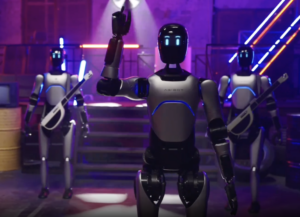
The A2 is positioned as a more comprehensive humanoid platform, designed to operate across a wider range of scenarios. It represents AgiBot’s longer-term bet on embodied AI: a robot capable of handling diverse tasks rather than narrowly optimized factory routines.
In that sense, the A2 is closer to the general-purpose humanoid vision pursued by Western competitors, while the G2 remains optimized for immediate industrial scalability. The A2 recently made headlines after walking 66 miles in three days, setting a new Guinness World Record.
This dual-track strategy — industrial specialization with the G2, broader embodiment with the A2 — allows AgiBot to address both short-term revenue and long-term technological positioning.
Robots Trained by AI
Beyond hardware, AgiBot is investing heavily in artificial intelligence to accelerate robot learning. The company claims its machines can learn certain complex industrial tasks in as little as ten minutes.
Its approach, branded “Real-World Reinforcement Learning,” combines human teleoperation with algorithmic optimization. Human operators first guide robots remotely through a task, generating real-world operational data. AI systems then refine and stabilize the movements autonomously.
AgiBot operates a dedicated robotic learning center where workers teleoperate robots to produce training data for its embodied AI models — a strategy designed to accelerate skill acquisition while building proprietary datasets.
In parallel, the company has diversified its commercial experimentation. In December, it launched Qingtian Rent, a robot rental platform offering humanoid and quadruped robots for events and commercial use. Through a WeChat mini-program, robots can be rented for trade shows, business meetings, concerts and weddings. Pricing ranges from around 500 yuan per day for the D1 Ultra quadruped to nearly 100,000 yuan per day for large-scale event packages.
A Global and Mainstream Strategy
AgiBot’s ambitions now extend far beyond China’s industrial ecosystem. The company is pursuing a deliberate global and mainstream positioning strategy.
Its presence at Mobile World Congress in Barcelona signals more than simple product promotion. By appearing at one of the world’s largest technology events — traditionally dominated by telecom and consumer electronics giants — AgiBot is positioning itself as a global technology brand rather than a niche robotics supplier.
At the same time, the company is venturing into cultural territory. After announcing its European expansion at a Munich launch event, AgiBot revealed a partnership with a Paris-based haute couture house, whose identity is expected to be disclosed soon.
When embodied intelligent robots step into the romantic world of Paris haute couture🤖💫
After announcing our entry into Europe at the Munich Launch Event🇩🇪, AGIBOT embarks on another cross-border exploration! Teaming up with a Paris🇫🇷 haute couture designer, our robots wander… pic.twitter.com/EZtxjXpE4K— AGIBOT (@AGIBOTofficial) February 28, 2026
Promotional materials show its humanoid robots walking through fashion boutiques and artistic Parisian streets — a carefully staged encounter between industrial intelligence and luxury craftsmanship.