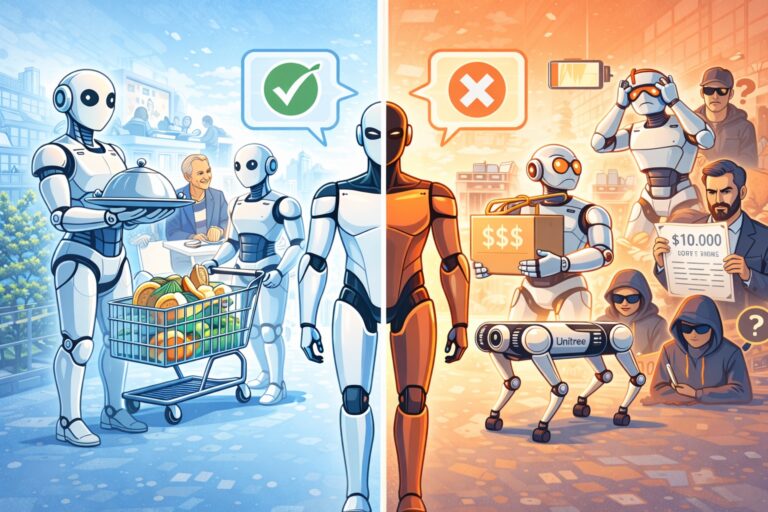
Humanoid robots are developing more and more, and in the coming years they could become part of our everyday lives at any moment—both in various places such as restaurants and supermarket checkouts, but also simply in our homes as assistants fully taking care of household tasks.
However, we are entitled to ask whether it is currently worthwhile to own such a robot. Indeed, the technology is still new and constantly evolving, and we should not forget that even the cheapest models require spending between $5,000 and $10,000.
It is therefore a significant investment that should not be underestimated, but through this article let us try to take stock of the already very real advantages and the disadvantages that still exist for the moment.
An ability to adapt to all situations
Humanoid robots are designed to resemble humans in the way they move and also in the way they grasp objects, as if they had hands.
This makes them extremely versatile in any environment; they can adapt and perform many tasks with such a basic set of capabilities.
Obviously, this is a major advantage because, unlike human beings, they can technically carry out their tasks non-stop and efficiently without the potential risk of human error.
In addition, beyond their ability to adapt, even though they could become a new workforce that might eliminate many jobs, in countries where the population is aging and requires care—whether at home or for carrying out heavy workloads—these humanoid robots are an obvious solution.
Consequently, they are already capable of adapting to most common situations and carrying heavy loads, which is a real advantage.
This is particularly the case with Atlas from Boston Dynamics which, although mainly a solution aimed at companies, can carry significant weights ranging from 30 to 50 kilograms.
Unfailing precision
From a technical standpoint, humanoid robots possess extremely precise dexterity. The technology is developing extremely quickly, and surpassing the hands of human beings is no longer a dream.
Of course, each robot has different dexterity depending on the needs and tasks it is supposed to perform, but they are capable of carrying out actions with an extremely high degree of precision.
This therefore helps reduce errors—particularly human errors—and, in industrial contexts, also reduces costs. Indeed, any mistake generally leads to a loss of time or even a loss of materials. Eliminating these errors is therefore a gain in both time and efficiency.
Endless productivity
Although this point may be more nuanced—especially for humanoid robots used by individuals, which have batteries and generally a battery life of 2 to 4 hours—the situation is different in the professional world.
Indeed, robots do not necessarily operate on batteries, or even if they do, companies can own several of them, allowing them to work 24 hours a day without interruption. This leads to productivity with no downtime and far greater efficiency.
To go further, although there is still the risk that many professions may disappear in favor of these humanoid robots, automated endless productivity also means lower costs in the long term.
Obviously, there are no salaries to pay, which generally represents a major expense for any company that requires a large workforce.
A significant investment
Although humanoid robots already have many advantages—particularly in the professional world, where they enable flawless productivity, limit errors, and perform tasks faster than humans with very high precision—they are far from perfect.
This is especially true for humanoid robots intended for individuals, but it also applies to businesses; everything is still far from being flawless.
The first obvious point, both for individuals and companies, is the cost of these machines. For the general public, buying a humanoid robot whose relevance, usefulness, and effectiveness are still uncertain—especially when it costs as much as a car—remains a difficult decision.
Of course, over the years and with the adoption of this new technology, costs should decrease so that the price becomes more reasonable, but for now it will not be accessible to everyone.
While, on the hardware side, these humanoid robots are becoming increasingly effective—especially in factories, where they outperform humans significantly due to the organized environment—the chaos of a home makes things much more complicated.
Indeed, these humanoid robots still need to learn, particularly in terms of their artificial intelligence, in order to operate fully in a home or even on the street to complete their tasks efficiently.
As a result, for now, they are extremely slow at performing even simple tasks and meticulous in analyzing their environment and adapting. Once again, over the years, this will improve and be resolved, but currently, it is still too fragile for individual users.
A questionable operating time
Where, once again, in the professional field, this disadvantage is less noticeable because robots can operate on mains power or companies can have a fleet, using some robots while others recharge their batteries. This solution, however, is not feasible for individuals given the cost of such a product.
As a result, not only do the batteries wear out over time, but their autonomy is generally only 2 to 4 hours of use. This allows for completing a few tasks, but depending on their operating speed, it is not much.
Battery life technology, as well as the overall lifespan of these machines, will need to become more reliable in the long term for this to be a practical and efficient long-term purchase.
Some ethical concerns
Rather than defining this point as a disadvantage, it is primarily an open question: what will the world look like if humanoid robots replace manual workers?
Today, many are concerned that the evolution of artificial intelligence will eliminate certain jobs. Humanoid robots could represent a kind of second wave in a few years, but this time affecting manual tasks.
From a safety perspective, artificial intelligence carries risks, because the more it develops, the more potentially intelligent it becomes and could pose a threat to us. Indirectly, even if humanoid robots are different, they could follow the same path with their own AI, even though numerous safeguards are in place.
On a more practical note, we are also justified in wondering what would happen if a programmer managed to bypass the security systems of such a humanoid robot to equip it with a weapon.
https://t.co/tPKtplxNUB pic.twitter.com/gjY4ZsOrkY
— Tesla (@Tesla) March 4, 2026
To conclude, this technology is a logical evolution that will happen and eventually become standard. Of course, it will still take a few years; for now, we are only at the beginning. However, many companies, such as Tesla, are determined to bring humanoid robots into our lives as quickly as possible.