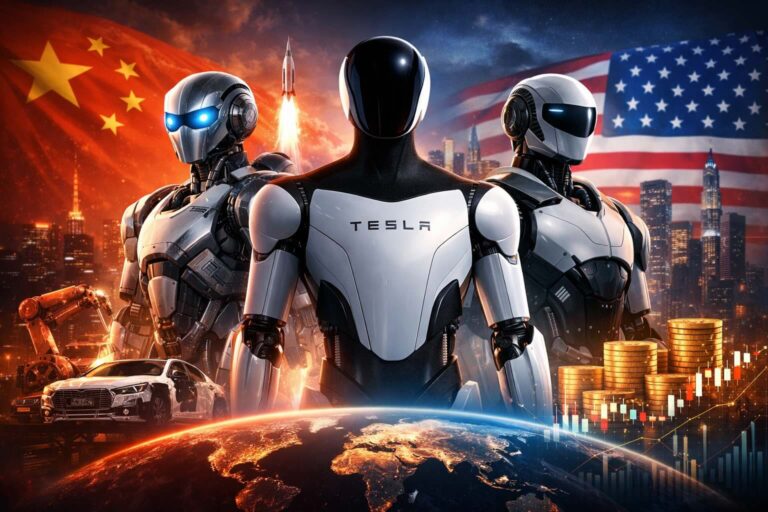
The humanoid robots market in 2026 is no longer a speculative future scenario. It is an emerging industrial sector shaped by geopolitical rivalry, artificial intelligence breakthroughs, manufacturing scale, and the economics of labor automation. What began as a collection of viral demos and research prototypes is now becoming a strategic battleground between China and the United States, with Tesla positioned at the center of the Western response.
In 2025, between 13,000 and 18,000 humanoid robots were sold globally. Nearly 90% of those units came from Chinese companies. The numbers remain small compared to traditional industrial robotics or electric vehicles, but they mark a structural shift. Humanoid robots are moving from laboratories into early commercial deployment, and the distribution of power in this early phase may shape the industry for decades.
Companies such as Unitree and Agibot have shipped thousands of humanoids. Shenzhen-based LimX Dynamics is already expanding internationally. On the American side, Tesla, Figure AI and Agility Robotics are scaling more cautiously, focusing on autonomy and AI performance.
According to long-term projections from major financial institutions, the humanoid robot market could reach $38 billion by 2035 and potentially expand toward $5 trillion by 2050. These estimates assume widespread enterprise adoption, dramatic cost reductions, and breakthroughs in embodied AI. While those numbers are speculative, they highlight the scale of ambition attached to this sector.
Humanoid Robots Market Size and Growth in 2026
The humanoid robots market in 2026 remains in its early growth phase. Installations are still concentrated in research labs, government-backed pilot programs and industrial test environments. China accounted for more than 85% of global deployments in 2025, while the United States represented roughly 13%. Other regions remain marginal players for now.
Revenue is difficult to standardize because pricing varies widely depending on configuration and capability. Base models from Chinese manufacturers can fall in the $13,000 to $23,000 range, while Western projections remain higher without large-scale production. The cost curve will be decisive. If prices decline rapidly while performance improves, enterprise adoption could accelerate significantly.
In the short term, 2026 is defined by experimentation and controlled industrial rollouts. In the medium term, from 2028 to 2035, analysts expect broader enterprise deployments in logistics and manufacturing. Beyond 2035, more ambitious forecasts envision tens of millions of units annually, though such projections depend heavily on technical breakthroughs that are not yet guaranteed.
Why China Leads the Humanoid Robot Market
China’s early dominance is not accidental. The sector was designated a priority industry in the country’s 14th Five-Year Plan in 2021, unlocking public investment, infrastructure support and ecosystem development. This approach closely mirrors the strategy used to build global leadership in electric vehicles and battery production.
Companies like Unitree sold approximately 5,500 humanoids in 2025, while Agibot shipped more than 5,000 units. Collectively, Chinese firms delivered roughly 13,000 robots worldwide, dramatically outpacing American competitors. Even Tesla’s publicly stated goal of producing 5,000 humanoids in 2025 was not achieved.
China’s advantage rests on vertically integrated supply chains. The country controls critical inputs such as rare earth materials, high-performance magnets, actuators, batteries and power electronics. Humanoid robots are complex electromechanical systems requiring precise hardware coordination. Unlike purely digital AI platforms, they depend on manufacturing depth and component reliability. China’s domestic ecosystem reduces cost and shortens iteration cycles.
Pricing illustrates the impact. Unitree advertises its G1 humanoid at roughly $13,500 base price. LimX Dynamics offers its base model around $22,660. These price points are significantly lower than early Western expectations. Lower pricing accelerates deployment, and deployment generates operational data that improves AI systems over time. In embodied AI, scale and data are deeply interconnected.
Tesla and the American Strategy: Betting on Advanced AI
While China dominates early shipments, the United States is betting that intelligence, not volume, will define long-term value. Tesla’s Optimus robot embodies that strategy.
Under the leadership of Elon Musk, Tesla has positioned Optimus as a general-purpose humanoid capable of performing factory tasks before expanding into broader applications. Optimus units are already operating inside Tesla facilities for limited tasks, and public sales are projected for late 2027.
Tesla’s approach prioritizes advanced autonomy, multi-step reasoning and adaptability in unstructured environments. The assumption is that hardware can be scaled later, but superior AI capability is harder to replicate. If Optimus demonstrates reliable task chaining, real-time decision-making and long-duration operation, it could command premium pricing and enterprise trust.
Other American players such as Figure AI and Agility Robotics are also focusing on embodied AI systems capable of interacting dynamically with complex environments. Analysts frequently emphasize that choreographed demonstrations do not equate to economic productivity. What matters is reliability over hours of operation, precision manipulation, error recovery and the ability to integrate into real industrial workflows.
The AI model race remains open. If breakthroughs in embodied intelligence occur primarily in the United States, the competitive balance could shift. If Chinese firms close the AI gap while maintaining manufacturing scale, their dominance could deepen.
Enterprise Use Cases Driving Market Expansion
In 2026, the humanoid robot market is fundamentally enterprise-driven. Most deployments are concentrated in structured industrial settings where tasks can be partially standardized.
Manufacturing represents the most immediate opportunity. Factories are designed for human workers, and a bipedal robot capable of using existing tools theoretically requires less infrastructure redesign than fixed industrial arms. Potential applications include assembly assistance, quality inspection and material handling.
Logistics and warehousing environments also offer strong potential. Warehouses are complex, dynamic spaces that demand flexibility. A humanoid robot capable of navigating shelves, handling boxes and managing exceptions could provide productivity gains in e-commerce fulfillment centers.
Healthcare and elder care remain longer-term prospects. These sectors require high safety standards, advanced perception and delicate manipulation capabilities. Regulatory hurdles and reliability requirements make near-term adoption unlikely at scale, but demographic trends suggest strong long-term demand if technical barriers are overcome.
Economic Viability and Labor Impact
The central economic question is whether humanoid robots can achieve cost-effective productivity compared to human labor. In advanced economies, annual wages in manufacturing and logistics often exceed $40,000 to $60,000. If a humanoid robot priced between $15,000 and $25,000 can perform repetitive tasks reliably for multiple years, the return on investment becomes compelling.
However, total cost of ownership extends beyond purchase price. Maintenance, software updates, downtime risk and training costs must be factored into enterprise calculations. Reliability remains the critical bottleneck. Until humanoids demonstrate industrial-grade uptime, adoption will proceed cautiously.
If reliability improves and costs decline, the macroeconomic implications could be profound. Humanoid robots represent a universal automation interface, capable of operating in environments originally built for humans. Unlike fixed automation systems, they offer flexibility across sectors, potentially accelerating structural labor transformation.
Geopolitical Stakes and Market Fragmentation
The humanoid robot market is increasingly geopolitical. China is expanding into the Middle East and Europe, seeking to establish international partnerships. At the same time, U.S. policymakers are unlikely to tolerate deep dependency on Chinese humanoid supply chains for critical industries.
The precedent set by semiconductors and electric vehicles suggests that subsidies, export controls and industrial policy responses are likely. The market may fragment into regional ecosystems rather than remain globally unified. Standards, software stacks and supply chains could diverge along geopolitical lines.
Tesla sits at the center of this dynamic. As a vertically integrated American manufacturer with AI ambitions, it represents a strategic counterweight to China’s hardware scale. Whether Tesla can accelerate production while maintaining AI leadership will shape the Western position in this emerging sector.
2026 as the Inflection Point
The humanoid robots market in 2026 is still small in volume but enormous in strategic importance. China leads in manufacturing scale, cost efficiency and early deployment. Tesla and other U.S. firms are focusing on advanced autonomy and long-term intelligence advantages.
The next two to three years will determine where deployment data accumulates, which companies establish industrial credibility and who defines technical standards. Early momentum matters because embodied AI improves through real-world exposure. Hardware scale and AI sophistication are reinforcing loops.
Humanoid robots are transitioning from experimental prototypes to early industrial assets. The race between China and Tesla is not simply about robotics; it is about manufacturing sovereignty, AI leadership and the future architecture of work.
The outcome remains uncertain. But 2026 marks the moment when the humanoid robot market moved from vision to measurable competition.